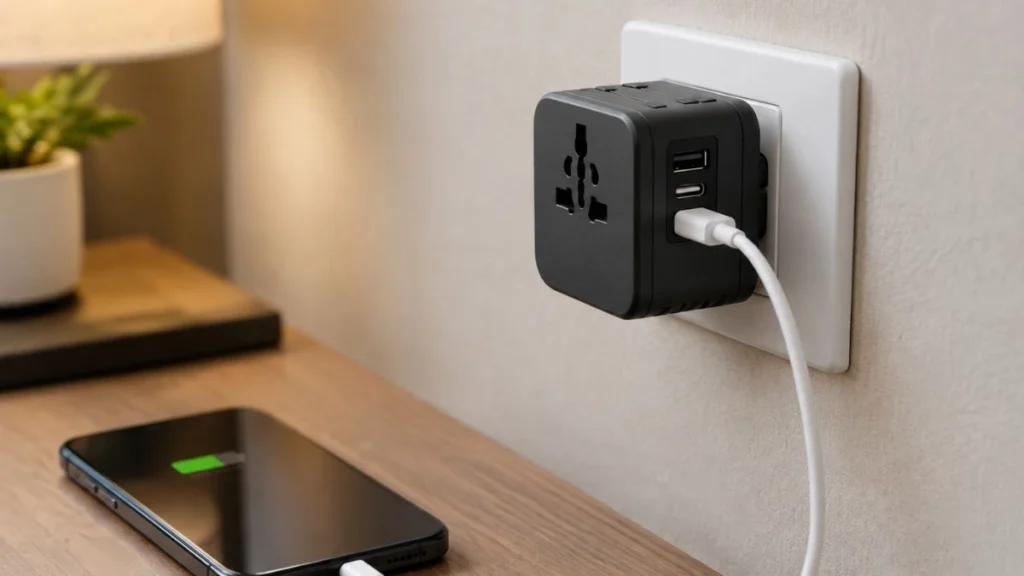
Most travelers only need a plug adapter, not a voltage converter — check your device’s power brick, and if it reads “Input: 100–240V, 50/60Hz,” it already handles any country’s voltage automatically and just needs the right plug shape. A voltage converter is only necessary for single-voltage appliances like some hair dryers, curling irons, or older electronics that aren’t rated for the full 100–240V range. The best universal adapters combine broad plug-type coverage, multiple USB-C/USB-A ports with real fast-charging wattage, and basic safety features like fuses and safety shutters.
The single most common mistake in travel adapter shopping is buying more than you need — specifically, assuming a voltage converter is required when a simple plug adapter would do the job. Getting this distinction right before you shop saves both money and unnecessary bulk in your bag.
Quick Facts
- Adapter vs. converter: A plug adapter only changes the physical plug shape; it doesn’t alter voltage. A voltage converter actually steps voltage up or down for devices that can’t handle the destination country’s electrical standard
- Check your device first: If your charger’s label reads “Input: 100–240V, 50/60Hz,” it’s dual-voltage and only needs a plug adapter, no converter required — this covers most phones, laptops, tablets, and cameras
- What actually needs a converter: Single-voltage appliances, most commonly hair dryers, curling irons, and some older electronics not rated for the full 100–240V range
- Plug type coverage: A genuinely universal adapter covers Types A, C, G, and I at minimum, covering most of North America, Europe, the UK, and Australia — but may not include less common types like Type D (India), Type J (Switzerland), Type L (Italy), or Type M (South Africa)
- USB charging wattage: Modern GaN-based adapters commonly offer 45–100W across USB-C ports, enough for laptop-grade charging on higher-wattage models — check whether your laptop specifically needs Power Delivery support at 30W or higher
- Safety features to look for: Fuses (ideally dual), safety shutters over unused outlet holes, and safety certifications like CE, FCC, or RoHS from a reputable brand
Why Most Travelers Don’t Need a Voltage Converter
This is the single most valuable piece of information in travel adapter shopping, and it’s often skipped over in favor of jumping straight to specific product recommendations. Nearly all modern electronics — phones, laptops, tablets, cameras — are built with dual-voltage power supplies designed to handle anywhere from 100V to 240V automatically, covering every country’s electrical standard without any conversion needed. The label on your charger brick will say this explicitly, typically as “Input: 100–240V, 50/60Hz” — if you see that, you only need a plug adapter to physically fit the destination country’s outlet, not a bulkier and more expensive voltage converter.
When You Actually Need a Converter
Voltage converters exist for a genuinely different category of device: single-voltage appliances that draw significant power and aren’t built to handle a range of input voltage. Hair dryers, curling irons, and straighteners are the most common examples, along with some older electronics manufactured before dual-voltage power supplies became standard. Using one of these devices on the wrong voltage without a converter isn’t just a compatibility issue — it can damage the device or, in some cases, create a genuine safety hazard, which is why checking a device’s voltage rating specifically matters more for these appliance categories than for standard electronics.
Plug Type Coverage: What “Universal” Actually Covers
Not every adapter labeled “universal” covers literally every plug type in the world, and it’s worth checking coverage against your specific destinations rather than assuming. Adapters commonly cover Types A, C, G, and I as a baseline, which handles most of North America, Europe, the UK, Ireland, Singapore, Hong Kong, and Australia. Less common plug types — Type D in India, Type J in Switzerland, Type L in Italy, and Type M in South Africa — aren’t always included even on adapters marketed as universal, so confirming your specific destination’s plug type against the adapter’s stated coverage is worth the extra minute before you travel.
USB Ports and Charging Speed
Modern travel adapters increasingly double as multi-device chargers, using GaN (gallium nitride) charging technology to deliver meaningfully faster charging in a smaller form factor than older adapter designs. Wattage varies significantly across models — many general-purpose travel adapters offer somewhere in the 45–65W range across their USB-C ports, while models specifically built for laptop charging can reach 70–100W or more. If you’re traveling with a laptop and want to charge it directly from the travel adapter rather than carrying a separate charger, checking that the adapter supports Power Delivery at a wattage your laptop actually requires (commonly 30W or higher for most ultrabooks) matters more than the adapter’s total number of ports.
Safety Features Worth Checking For
Basic safety features are worth prioritizing over saving a few dollars on a no-name adapter, particularly for something plugging directly into unfamiliar electrical systems. Look for built-in fuses (ideally a dual-fuse design, which protects the adapter even if one fuse fails), safety shutters covering unused outlet holes to prevent accidental contact, and recognized safety certifications like CE, FCC, or RoHS from an established brand. Adapters lacking these basics are more likely to be the ones associated with overheating or electrical safety complaints in independent testing.
Conclusion
The right travel adapter decision starts with correctly identifying whether you need a converter at all — and for the overwhelming majority of travelers carrying standard modern electronics, the answer is no, a plug adapter alone does the job. From there, matching plug-type coverage to your actual destinations, checking USB charging wattage against your specific devices (especially a laptop), and choosing a reputable brand with real safety certifications covers the practical decisions that actually matter.
FAQ
Do I need a voltage converter or just a plug adapter for international travel?
Check your device’s power brick label. If it reads “Input: 100–240V, 50/60Hz,” your device is dual-voltage and only needs a plug adapter to fit the destination outlet — no converter required. This covers most phones, laptops, tablets, and cameras.
What kind of devices actually need a voltage converter?
Single-voltage appliances that draw significant power, most commonly hair dryers, curling irons, and straighteners, along with some older electronics not rated for a full 100–240V input range.
Does a universal travel adapter cover every country’s plug type?
Not necessarily. Most universal adapters cover Types A, C, G, and I as a baseline, covering much of North America, Europe, the UK, and Australia, but may not include less common types like Type D (India), Type J (Switzerland), Type L (Italy), or Type M (South Africa) — worth checking against your specific destinations.
Can a travel adapter charge my laptop directly?
Some can, if the adapter supports Power Delivery at a high enough wattage — commonly 30W or more for most ultrabooks, with some travel adapters now reaching 70–100W. Check both your laptop’s required wattage and the adapter’s supported output before relying on it as your only laptop charger.
What safety features should I look for in a travel adapter?
Built-in fuses (ideally dual-fuse), safety shutters over unused outlet holes, and recognized safety certifications like CE, FCC, or RoHS from a reputable brand — these consistently correlate with fewer safety issues in independent testing compared to uncertified budget options.
Travel adapters connect to other packing-essentials topics — see Backpack Personal Item Rules and Is AirTag Worth It for Luggage? for related Flight Gear content.