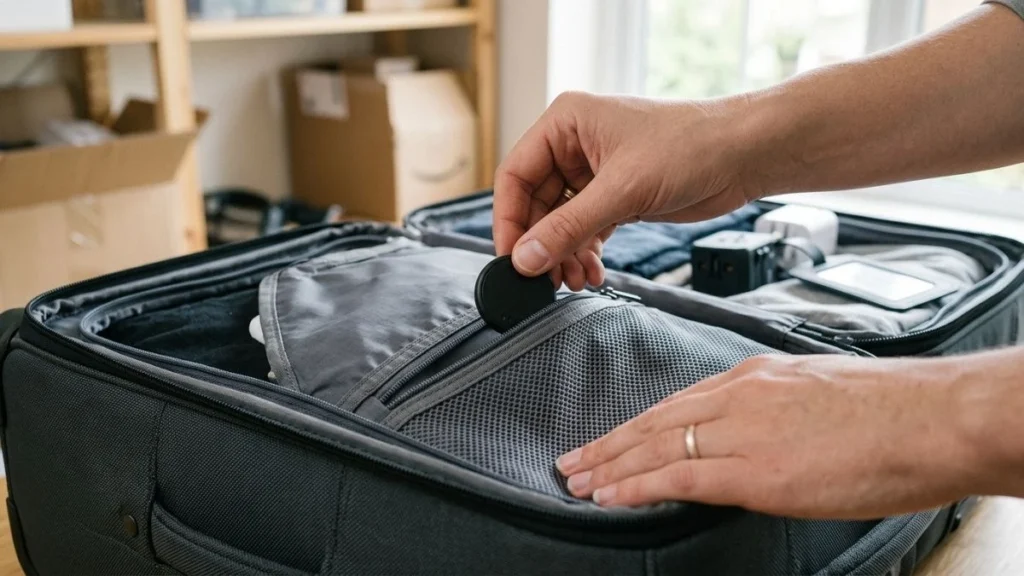
Yes, for most travelers — SITA’s 2026 Baggage IT Insights report found that bags carrying an Apple AirTag or other Find My network accessory saw a 90% reduction in truly lost (unrecoverable) status, and airlines using AirTag-integrated tracking saw delayed bags returned 26% faster. As of 2026, 36 airlines directly support Apple’s Share Item Location feature, letting you send an airline your bag’s live location rather than just seeing it yourself. It doesn’t change your legal rights if a bag is lost, but it gives you — and the airline — real, actionable location data that speeds up recovery.
For years, an AirTag in a checked bag was a private comfort: you could watch your suitcase’s dot sitting in the wrong city on a map, but you still had to convince a skeptical airline agent who had no way to see what you were seeing. That gap has closed. A growing number of airlines can now read an AirTag’s shared location directly, turning what used to be a personal hunch into something an airline’s baggage desk can actually act on.
Quick Facts
- Effectiveness: SITA’s 2026 Baggage IT Insights found bags with an AirTag or Find My accessory saw a 90% reduction in truly lost (unrecoverable) status, and a 26% faster recovery time for delayed bags on integrated airlines
- Airline support (2026): 36 airlines support Apple’s Share Item Location feature, letting you send a temporary, secure link showing your bag’s live location directly to the airline’s baggage team
- How sharing works: On iOS 18.2 or later, open Find My, select the item, tap Share Item Location, and send the link — the airline sees a live map with no login required, and the link expires automatically after 7 days or once you’re reunited with the bag
- Biggest cause of delayed bags: Transfer baggage mishandling (bags failing to make a connecting flight) accounts for roughly 39% of all mishandling cases, making trackers especially useful on connecting itineraries
- Doesn’t replace your rights: A tracker helps locate a bag faster, but it doesn’t change your right to delayed-bag delivery, reasonable expense claims, or compensation if a bag is formally declared lost
- Limitations: An AirTag relies on nearby Apple/Android devices to update its location — a bag sitting in a cargo area with no nearby phones (like an airport at 2 a.m.) won’t update in real time until someone with a phone comes close enough
What the Data Actually Shows
The headline figures here come from a credible, non-marketing source: SITA WorldTracer, the baggage tracking system used by roughly 500 airlines and 2,800 airports worldwide, published in its 2026 Baggage IT Insights report. According to that data, bags fitted with an Apple AirTag or another Find My network accessory saw a 90% reduction in truly lost status — meaning the small share of bags that never get reunited with their owner at all — and airlines using Apple’s Share Item Location integration specifically saw delayed bags returned 26% faster than without it. This isn’t a single vendor’s promotional claim; it’s aggregate data across the exact infrastructure most global airlines already use to track baggage.
How Airline Sharing Actually Works
The feature that changed the calculus here is Apple’s Share Item Location, which lets you temporarily share your AirTag’s live position directly with an airline rather than just viewing it yourself. On an iPhone running iOS 18.2 or later, you open the Find My app, select the item in your missing bag, and tap Share Item Location to generate a link. The airline’s baggage team sees a live map of your bag’s location without needing to log into anything, and the sharing link isn’t left open indefinitely — it automatically stops working after seven days, or immediately if you tap Stop Sharing once you’re reunited with the bag. This closes the gap that used to exist between “I can see where my bag is” and “the airline can act on that information.”
Why Connecting Flights Are Where This Matters Most
Baggage mishandling isn’t evenly distributed across all types of trips — transfer baggage issues, where a bag fails to make it onto a connecting flight, account for roughly 39% of all mishandling cases, by far the largest single cause. This is exactly the scenario where a tracker adds the most practical value: rather than waiting on hold or hoping an airline’s manual tracking system catches up, you have independent, real-time confirmation of whether your bag actually made the connection or got left behind at the transfer point.
What a Tracker Doesn’t Do
It’s worth being precise about the limits here, since a tracker isn’t a substitute for your actual passenger rights. Knowing where a delayed or lost bag is doesn’t change your entitlement to delayed-bag delivery once it’s located, your ability to claim reasonable expenses incurred while waiting, or your right to compensation if a bag is eventually declared permanently lost. What it changes is the quality of information available while that process plays out — instead of arguing with an agent about where your bag might be, you and the airline are looking at the same map.
The Real-World Limitation Worth Knowing
An AirTag isn’t a live GPS tracker in the way people sometimes assume — it relies on the Find My network, meaning nearby Apple (and increasingly Android) devices detect the AirTag’s Bluetooth signal and relay its location. In a busy airport terminal with hundreds of phones nearby, this updates frequently and reliably. In a more isolated environment — a cargo storage area overnight, or a remote regional airport with little foot traffic — location updates can lag until a phone happens to come within range. It’s a genuinely useful tool for gathering evidence and applying pressure at a service counter, not a guaranteed real-time feed under every circumstance.
Conclusion
The evidence for AirTags (and similar Find My accessories) in checked luggage is no longer anecdotal — SITA’s 2026 industry data shows a genuine, substantial reduction in truly lost bags and faster recovery specifically where airlines have integrated location-sharing directly into their process. For the relatively small upfront cost of a single tracker, the practical value is highest for travelers who fly connecting itineraries regularly, since that’s where the largest share of baggage mishandling actually happens.
FAQ
Does an AirTag actually reduce lost luggage, or is that just marketing?
It’s backed by independent industry data. SITA’s 2026 Baggage IT Insights, drawn from the WorldTracer system used by roughly 500 airlines and 2,800 airports, found a 90% reduction in truly lost bags and a 26% faster recovery time for delayed bags where AirTag/Find My integration was used.
How do I share my AirTag’s location with an airline?
On iOS 18.2 or later, open Find My, select the item in your bag, tap Share Item Location, and send the generated link to the airline. The link shows a live map with no login required and expires automatically after 7 days or once you’re reunited with the bag.
Do all airlines support AirTag location sharing?
Not all, but a growing number — 36 airlines directly supported Apple’s Share Item Location feature as of 2026. It’s worth checking whether your specific airline participates before relying on it as your primary recovery method.
Does having an AirTag change my rights if my bag is lost?
No. A tracker helps you and the airline locate a bag faster, but it doesn’t change your existing rights to delayed-bag delivery, reasonable expense claims, or compensation if the bag is formally declared lost.
Why are AirTags especially useful for connecting flights?
Because transfer baggage mishandling — a bag failing to make it onto a connecting flight — is the single largest cause of baggage delays, accounting for roughly 39% of all cases. A tracker gives you independent confirmation of whether your bag actually made the connection.
Luggage tracking connects to other packing-essentials topics — see Backpack Personal Item Rules and Checked Bags During Transit for related Flight Gear and Airports content.
Official Sources
- Euronews — AirTags in Luggage Actually Helps, With a 90% Reduction of Truly Lost Bags in a Year — directly cites official SITA 2026 Baggage IT Insights data on the reduction of truly lost bags and faster recovery times for delayed bags