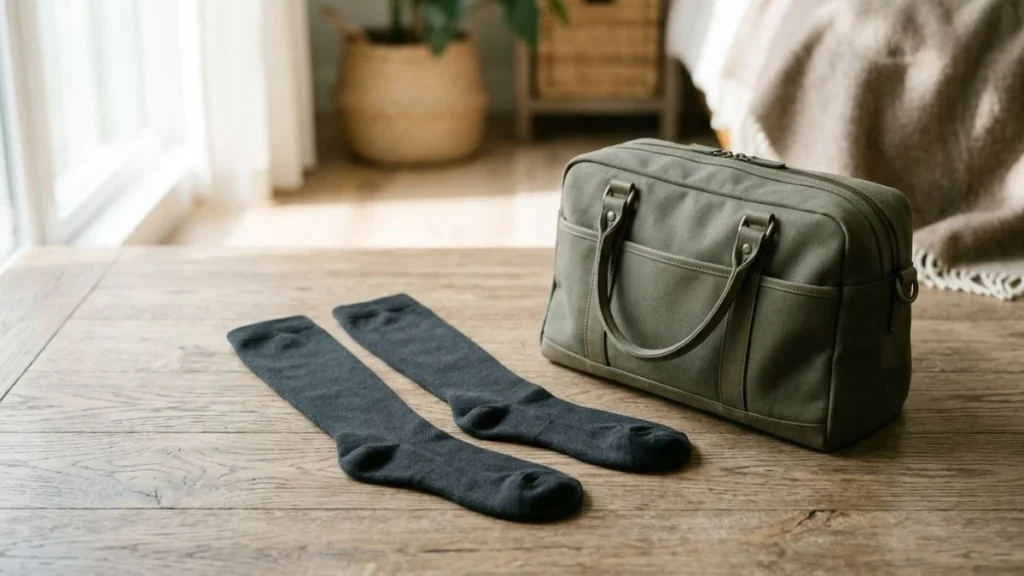
For most healthy travelers, 15–20 mmHg graduated compression knee-high socks are the right choice for flights — enough to meaningfully reduce leg swelling and support circulation on flights over four hours without needing a prescription. Travelers with a history of DVT, varicose veins, or other circulation conditions may be advised toward 20–30 mmHg, but that stronger tier should be discussed with a doctor first rather than chosen based on general travel advice alone.
Sitting still for hours at altitude does something specific to your legs: cabin pressure, low humidity, and prolonged immobility together slow venous return, letting blood pool in your lower legs. Some research suggests a majority of passengers experience measurable leg swelling on flights over seven hours. Compression socks address this directly by applying graduated pressure that helps push blood back toward the heart even while you’re sitting still — but picking the right pair means understanding a couple of specifics most people skip past.
Quick Facts
- Right compression level for most travelers: 15–20 mmHg graduated compression, sufficient for reducing swelling and leg fatigue on flights over four hours without a prescription
- Higher-tier option (20–30 mmHg): Generally reserved for travelers with a history of DVT, varicose veins, or chronic venous insufficiency — recommended to consult a doctor before using this stronger level
- Length: Knee-high (calf-length) is the standard for flight use, rather than ankle-length or full compression tights
- When it matters most: Flights over 4 hours; compression is generally considered optional for healthy travelers on shorter flights
- Sizing over strength: A correctly-sized 15–20 mmHg sock delivers more real benefit than an ill-fitting 20–30 mmHg sock — measure calf circumference, not shoe size, to choose the right fit
- Timing: Put socks on before heading to the airport, not after you’re already seated — starting with good circulation is easier than reversing swelling that’s already begun
Understanding the mmHg Number
The compression level, measured in millimeters of mercury (mmHg), is the single most important spec to understand before buying, since it directly determines how much pressure the sock applies and what it’s actually suited for. Compression socks aren’t a one-size-fits-all product — they’re categorized into different pressure tiers, and picking the wrong one either wastes money on more compression than you need or fails to deliver the support a specific condition might call for. For general travel use by a healthy adult, mild-to-moderate 15–20 mmHg compression is consistently the tier recommended across medical and travel guidance, delivering meaningful benefit without requiring a prescription or medical supervision.
When 20–30 mmHg Makes Sense (and When It Doesn’t)
The stronger 20–30 mmHg tier is the range used in clinical research specifically demonstrating DVT risk reduction, and it’s generally recommended for travelers with a documented history of DVT, varicose veins, chronic venous insufficiency, or those on especially long flights of eight or more hours. It’s worth being direct about this: this isn’t a “more is better” situation you should default into on your own. Multiple sources consistently recommend consulting a physician before stepping up to this level, particularly for travelers with existing circulatory conditions, peripheral arterial disease, or diabetes with neuropathy, where compression socks may need to be avoided or adjusted under medical guidance rather than chosen based on general travel advice.
Why Fit Matters More Than Strength
This is a detail that gets undersold in a lot of compression sock marketing: a well-fitted 15–20 mmHg sock delivers more real therapeutic benefit than a 20–30 mmHg sock worn in the wrong size. Compression works through graduated pressure applied precisely across the leg — a sock that’s too loose won’t apply meaningful pressure at all, while one that’s too tight can restrict circulation in ways that work against the intended benefit. The correct approach is measuring your actual calf circumference, not simply buying based on your usual shoe or clothing size, since calf measurements vary independently of both.
Knee-High Is the Standard for a Reason
Among the different compression garment lengths available, knee-high (calf-length) socks are the consistent standard recommendation specifically for flight use, rather than ankle socks or full compression tights. This length targets the specific area where blood pooling and swelling most commonly occur during prolonged sitting, while remaining more practical to put on, wear comfortably for hours, and remove than a full-leg option — without sacrificing the coverage that actually matters for flight-related circulation support.
Timing and Practical Use
Compression socks work best as a preventive measure rather than a fix applied after the fact — putting them on before you head to the airport, rather than once you’re already seated and swelling has begun, is consistently the recommended approach across travel health guidance. Wearing them for the full flight, and continuing for an hour or two after landing, extends the circulation benefit through the period when blood pooling is still resolving, rather than removing them the moment you’re off the plane.
Conclusion
Compression socks are one of the more evidence-supported, low-effort tools available for reducing leg swelling and supporting circulation on long flights — but getting real benefit from them depends on choosing the right compression level for your specific situation (15–20 mmHg for most healthy travelers, 20–30 mmHg only with medical guidance), the correct knee-high length, and above all, the correct size based on your actual calf measurement rather than guesswork.
FAQ
What compression level is best for flying?
For most healthy travelers, 15–20 mmHg graduated compression is sufficient to reduce swelling and leg fatigue on flights over four hours, without requiring a prescription. Higher levels (20–30 mmHg) are generally reserved for travelers with specific circulation conditions, and should be discussed with a doctor first.
Do compression socks actually help prevent blood clots on flights?
Compression socks support circulation by applying graduated pressure that helps counteract blood pooling during prolonged sitting, and the 20–30 mmHg range specifically is the compression level used in clinical research on DVT risk reduction. They’re considered a preventive measure, not a guaranteed treatment, and shouldn’t replace medical guidance for travelers with existing risk factors.
Should I choose knee-high or full-length compression socks for a flight?
Knee-high (calf-length) is the standard recommendation for flight use, since it targets the area where blood pooling most commonly occurs while remaining more practical to wear comfortably for a long flight than full-length options.
When should I put on compression socks before a flight?
Before heading to the airport, not after you’re already seated on the plane. Starting with good circulation is easier than trying to reverse swelling that’s already begun once a flight is underway.
How do I know what size compression socks to buy?
Measure your calf circumference directly rather than basing your choice on shoe size or general clothing size, since a correctly-fitted lower-compression sock delivers more real benefit than a stronger one that doesn’t fit properly.
Compression sock use connects to other in-flight wellbeing topics — see How to Avoid Jet Lag and How to Sleep on a Plane for related Flight Hacks content.
This is general travel-comfort information, not medical advice — travelers with a history of DVT, varicose veins, peripheral arterial disease, diabetes with neuropathy, or other circulation-related conditions should consult a healthcare provider before choosing a compression level.
Official Sources
No single government or official authority source was used; the mmHg and compression recommendations are drawn from several independent health/travel publications (including clinic-affiliated sources) that are consistent with each other as of mid-2026, rather than a single claim requiring one authoritative reference. Because this article touches on a health topic (DVT), additional verification against official medical sources (e.g. CDC/NHS) is recommended before publishing, and the article explicitly directs readers to consult a healthcare professional for specific conditions.