Last updated: 3 August 2026
Wake turbulence is the disturbed air an aircraft leaves behind as it generates lift — specifically a pair of counter-rotating vortices trailing off the wingtips. Every aircraft creates it, but it’s strongest behind heavy aircraft flying slowly with a clean wing configuration, which is exactly the situation during takeoff and landing. It’s the reason air traffic control enforces minimum spacing between aircraft, particularly a smaller plane following a much larger one.
Unlike the bumpy turbulence caused by weather — the kind that makes the seatbelt sign come on mid-cruise — wake turbulence isn’t a weather phenomenon at all. It’s a direct byproduct of how a wing produces lift, meaning it exists any time an aircraft is flying, generated entirely by the aircraft itself rather than atmospheric conditions. That distinction matters because it’s also why controllers can predict and manage it with spacing rules, rather than reacting to it the way they do with storm systems.
Quick Facts
- What it is: Counter-rotating vortices trailing behind an aircraft’s wingtips, formed as a direct result of the wing generating lift
- Where it’s most hazardous: Behind an aircraft during takeoff, approach, and landing — the phases where wake vortices form strongest, per FAA guidance
- What drives its strength: Weight, speed, and configuration of the generating aircraft — heavier, slower, “clean” (flaps/gear retracted) generates the strongest wake
- Who manages the risk: Air Traffic Control sets minimum separation standards between a “leader” and “follower” aircraft, and issues Wake Turbulence Cautionary Advisories to pilots
- Not weather-related: Wake turbulence is generated by the aircraft itself, unlike atmospheric turbulence caused by wind and weather systems
- Modern refinement: The FAA’s “wake recategorization” program updates separation standards using wingspan, weight, approach speed, and other aircraft-specific factors rather than a single blunt weight-based rule
How Wake Vortices Actually Form
A wing generates lift by creating a pressure difference between its upper and lower surfaces — lower pressure above, higher pressure below. At the wingtip, that pressure difference has nowhere to resolve neatly, so air spills around the tip from the high-pressure underside to the low-pressure topside, rolling into a pair of tight, counter-rotating vortices that trail behind the aircraft. Every aircraft that generates lift produces this effect to some degree; it’s an unavoidable byproduct of flight, not a malfunction or a design flaw.
Why Takeoff and Landing Are the Danger Zone
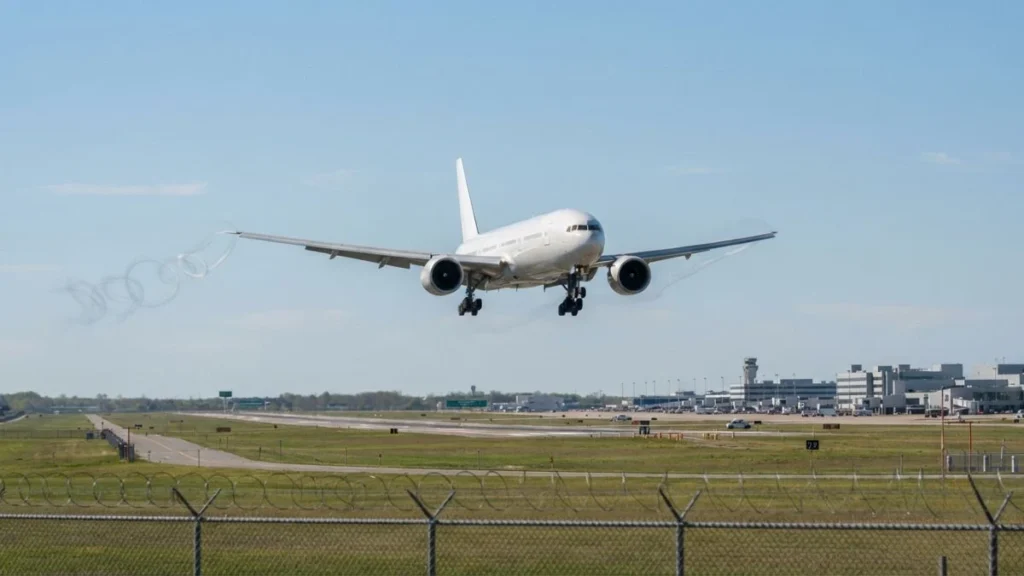
Wake vortices are strongest exactly when an aircraft needs the most lift relative to its speed — heavy, slow, and with flaps and landing gear extended, which describes takeoff and landing almost precisely. That’s why the FAA specifically flags these phases as when wake turbulence encounters are most hazardous: a following aircraft, especially a smaller one, can hit a strong vortex at low altitude with little room to recover. Encountering a strong wake vortex can impose rolling forces that exceed a smaller aircraft’s control authority, which is exactly the scenario separation standards are built to prevent.
How Controllers Manage the Risk
Air traffic control handles wake turbulence primarily through minimum separation standards between a “leader” aircraft (the one generating the wake) and a “follower” aircraft coming behind it, particularly when the follower is smaller. For decades, these standards were based mainly on the leading aircraft’s maximum takeoff weight, but ongoing FAA research has refined this into a more precise system — the wake recategorization program — that factors in wingspan, weight, final approach speed, and roll-moment capability rather than weight alone. This research-driven refinement has, in some cases, safely reduced required separation distances, increasing airport capacity without compromising the safety margin the original rules were built to protect.
What Pilots Are Trained to Do
The FAA places direct responsibility on pilots to understand and avoid wake vortex encounters — visualizing how the wake from a similar or larger aircraft ahead is likely to behave and move, adjusting flight paths proactively, and staying alert specifically during takeoff, approach, and landing. When ATC is providing separation services, controllers share this responsibility, but pilots operating at uncontrolled airports, accepting a visual approach clearance, or flying under visual flight rules outside controlled airspace take on full responsibility for avoiding wake encounters themselves.
Conclusion
Wake turbulence is a predictable, well-understood consequence of how wings generate lift — not a random hazard, but one with a known cause, known danger zones (takeoff and landing), and a mature system of separation standards and pilot training built specifically to manage it. The refinement of those standards over recent years, using more precise aircraft-specific data rather than blunt weight categories, is a direct example of aviation safety research translating into both better protection and more efficient airspace use.
FAQ
What causes wake turbulence?
Wake turbulence is caused by the aircraft itself, not weather — it’s a pair of counter-rotating vortices that form at the wingtips as a direct byproduct of the wing generating lift. Every aircraft produces it in flight to some degree.
When is wake turbulence most dangerous?
During takeoff, approach, and landing, according to FAA guidance. These are the phases where an aircraft operates at a high angle of attack with the most lift generated relative to speed, producing the strongest vortices, and where following aircraft have the least altitude to recover from an encounter.
How do air traffic controllers prevent wake turbulence accidents?
Primarily through minimum separation standards between a generating (“leader”) aircraft and a following aircraft, especially when the follower is smaller. The FAA’s wake recategorization program has refined these standards using factors like wingspan, weight, and approach speed rather than weight-based categories alone.
Is wake turbulence the same as regular in-flight turbulence?
No. Regular turbulence is generally caused by weather and atmospheric conditions. Wake turbulence is generated entirely by an aircraft itself as a byproduct of producing lift, and exists independently of weather.
Can smaller planes really be affected by a larger plane’s wake?
Yes. A strong wake vortex from a larger, heavier aircraft can impose rolling forces on a following smaller aircraft that exceed its roll-control capability, which is precisely why separation standards exist and why smaller aircraft require greater spacing behind heavier ones.
This connects to other in-flight physics explainers in the same cluster — see ETOPS Explained and Why Turbulence Happens for more on how aviation safety systems are built around predictable, well-understood physical forces.