Last updated: 3 August 2026
Airplane seats recline because a pneumatic or mechanical linkage in the seat base tilts the seatback backward on a pivot, a comfort feature airlines chose to include — not something required by aviation safety regulators. In fact, the opposite is true where safety is concerned: seats must be upright and locked during takeoff and landing specifically because that position is safer in an emergency and allows for faster evacuation. Recline is purely a mid-flight comfort option, and in recent years, airlines have increasingly been removing it altogether on some aircraft to cut weight, maintenance cost, and passenger conflict.
The recline button is one of the most disproportionately controversial features on an airplane — a small mechanical convenience that regularly turns into the flashpoint for the tensest exchanges between strangers at 35,000 feet. Understanding what’s actually happening mechanically, and why airlines built it this way in the first place, makes the whole recline debate a lot less mysterious, even if it doesn’t make it any less annoying when it happens to you.
Quick Facts
- How it works: A hidden mechanism under the seat cushion — a pivot, connecting wires to the armrest button, and a pneumatic canister — tilts the seatback and returns it upright
- Not a safety feature: Recline exists purely for comfort; regulators actually require the opposite — seats locked upright during takeoff and landing, because that position is safer in an emergency and enables faster evacuation
- Who “owns” the space: In the US, the FAA declined to regulate seat recline in 2018, leaving seat design and etiquette entirely to individual airlines
- Weight cost: Modern lightweight airline seats weigh roughly 7–10 kg (15–22 lbs) per passenger, and recline mechanisms add measurable weight and mechanical failure points to that
- The trend: Since the late 2000s, a new generation of ultra-lightweight, non-reclining seats has entered service on some airlines, particularly on short-haul routes, specifically to cut weight and maintenance costs
- Why airlines still avoid banning it outright: Beyond the passenger backlash, removing recline entirely on long-haul routes remains commercially unpopular even as it’s become more common on short flights
What’s Actually Happening When You Recline
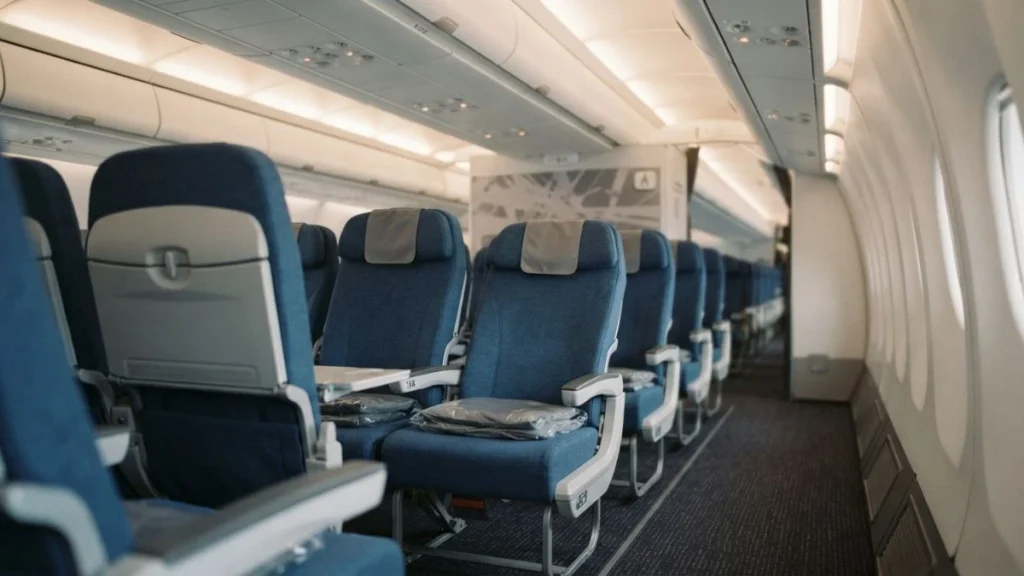
Seatmakers call the internal parts “kinematics” — the moving components that let a seatback tilt backward and return upright. At its simplest, there’s a pivot point built into the seat structure, wires or a cable running from that pivot to the button on your armrest, and a pneumatic canister that provides the resistance and return force. Press the button, the pivot releases, and gravity (plus your own lean-back) tilts the seatback; release the button once you’re at the angle you want, and the mechanism locks it in place until you press it again.
Why It Isn’t a Safety Feature
It’s worth being precise about what regulators actually require here, because it’s the opposite of what recline gives you: seats must be upright and locked during takeoff, landing, and any time the seatbelt sign requires it, specifically because an upright seatback is safer in the event of an emergency and doesn’t obstruct the path to an exit during evacuation. Recline itself was never mandated or even formally regulated by aviation authorities — in the US, the FAA specifically declined to set rules around recline space in 2018, effectively leaving seat design, spacing, and the resulting etiquette entirely up to individual airlines to sort out.
Why Airlines Are Removing It
The trend toward non-reclining seats, especially on short-haul and low-cost routes, comes down to three overlapping cost pressures for airlines. First, maintenance: any mechanism with moving parts is prone to breaking down, whether from normal wear or rougher-than-intended passenger use, and a broken recline mechanism is a maintenance ticket an airline would rather not deal with. Second, weight: recline mechanisms add measurable mass per seat, and across an entire aircraft’s economy cabin, that adds up to real fuel cost over the life of the aircraft. Third — and often the most publicly visible reason — is the disruption cost: seat-recline disputes between passengers are common enough that flight attendants regularly have to intervene, and in rare cases, disputes escalating over reclining space have led to flight diversions.
Who Actually “Owns” the Recline Space
This is the part that fuels most in-flight recline arguments: neither the passenger reclining nor the passenger being reclined into technically “owns” that wedge of space — the airline does, and in a fairly literal commercial sense, it sells the same physical space to two different passengers. The passenger in front is sold the ability to recline into it; the passenger behind is sold the legroom that recline then encroaches on. Most airlines’ informal position is that the passenger controlling the recline button has the right to use it, but airlines generally avoid stating this explicitly or enforcing it consistently, which is part of why the etiquette question never gets a clean, universally accepted answer.
Conclusion
Recline is a comfort feature airlines chose to build in, not a safety requirement — regulators actually mandate the opposite position (upright and locked) during the exact moments when safety matters most. Whether a given flight even has reclining seats increasingly depends on route length and airline cost strategy rather than any regulatory standard, and the ongoing shift toward non-reclining seats on short-haul aircraft is a direct response to the weight, maintenance, and passenger-conflict costs recline mechanisms carry.
FAQ
Why do airplane seats have to be upright for takeoff and landing?
Because an upright, locked seatback is safer in the event of an emergency and doesn’t obstruct the path to an exit if a rapid evacuation is needed. This is a genuine safety requirement, unlike recline itself, which is purely a comfort feature with no safety mandate behind it.
Is it rude to recline your airplane seat?
There’s no official rule either way — the FAA declined to regulate seat recline space in 2018, leaving it up to airline and passenger norms. Most airlines’ informal position is that the passenger with the recline button has the right to use it, though etiquette expectations vary and aren’t consistently enforced.
Why are some airplane seats now unable to recline at all?
Airlines have increasingly removed recline mechanisms, especially on short-haul and low-cost routes, to reduce weight, cut maintenance costs from a mechanism prone to breaking, and avoid the passenger conflicts that seat-recline disputes regularly cause.
Does reclining your seat use extra fuel?
Not meaningfully during use, but the recline mechanism itself adds permanent weight to every seat it’s installed in, which does add up to real fuel cost across an aircraft’s economy cabin over its operating life — part of why some airlines have removed the mechanism entirely.
Who is legally responsible if passengers fight over seat recline?
There’s no specific regulation governing this; it’s treated as a passenger conduct issue managed by the airline and flight crew in the moment. In rare, serious cases, disputes over reclining space have escalated enough to cause a flight to divert.
This connects to other cabin-experience explainers in the same pillar — see Does a Backpack Count as a Personal Item? and How to Sleep on a Plane for more on getting comfortable in economy.