Heathrow runs four active terminals — 2, 3, 4, and 5 — grouped roughly into three zones, and every connecting passenger must clear UK security again regardless of where they arrived from, per Heathrow’s own guidance. A same-terminal connection needs about 60–90 minutes; a terminal change needs 90 minutes or more, since it involves a free shuttle bus or train plus a fresh security screening at the new terminal. Self-transfer passengers on separate tickets should plan for 3–4 hours, since none of the standard connection-time guidance applies to them.
Heathrow has a reputation as one of the more complex major hubs to connect through, and that reputation is fair — not because the airport is disorganized, but because its four terminals sit in genuinely separated zones requiring a bus, train, or walk between them, and because every connecting passenger, without exception, has to go through UK security again after landing.
Quick Facts
- Active terminals: 2, 3, 4, and 5 (Terminal 1 closed permanently in 2015, though outdated guides sometimes still list it)
- Rough terminal groupings: Terminals 2 and 3 sit close together (a short walk or free train); Terminal 5 is a separate western zone; Terminal 4 sits apart as well, reachable by free shuttle bus
- Security re-screening: Per Heathrow’s own guidance, all connecting passengers must go through security again, with no exceptions regardless of arrival origin
- Same-terminal connection: Roughly 60–90 minutes is the general recommendation
- Terminal-change connection: Roughly 90 minutes or more, accounting for the free shuttle bus or train plus a fresh security screening at the new terminal
- Self-transfer (separate tickets): Standard connection-time guidance doesn’t apply — plan for 3–4 hours, since you’ll need to collect baggage, clear UK immigration, and go through check-in and security again from scratch
- 2026 security update: CT scanners are now installed across all Heathrow terminals, meaning liquids and large electronics generally no longer need to be removed from cabin bags during screening within the airport
Why Heathrow’s Layout Adds Real Time to a Connection
Unlike an airport where every terminal shares one continuous secure zone, Heathrow’s four terminals are spread across genuinely separated buildings and zones. Terminals 2 and 3 sit close enough together to connect via a short walk or a free train, but Terminal 5 sits in its own western zone, and Terminal 4 is separated as well, reached by a free shuttle bus that runs roughly every 10 minutes. This structural reality — not confusing signage or inefficiency — is the main reason Heathrow connections involving a terminal change take meaningfully longer than a same-terminal transfer.
The Rule That Applies to Every Connecting Passenger
Per Heathrow’s own connections guide, every passenger connecting through the airport must clear UK security again before reaching their next flight’s departure lounge, regardless of which country they arrived from or how short their layover is. Large electronics and liquids up to 2 litres are allowed to remain in cabin baggage during this rescreening as of Heathrow’s 2026 CT scanner rollout across all terminals — a genuine improvement over the older process that required removing them — but the security step itself is universal and can’t be skipped, even for a very short connection.
The Actual Step-by-Step Process
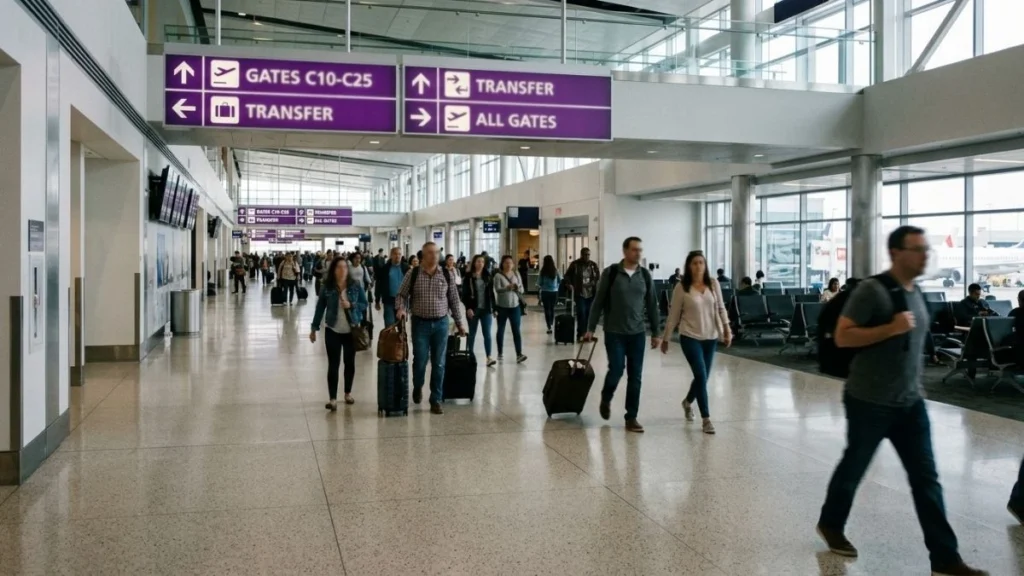
Heathrow’s official guidance lays out a consistent sequence for connecting passengers: after leaving the aircraft, follow the purple “Flight Connections” signs to the connections area, where screens display which terminal your onward flight departs from (though not gate information, which appears closer to departure). From there, continue following the purple signs — this may mean boarding a free shuttle bus if your next flight departs from a different terminal — before passing through security again and entering the new departure lounge to await your gate. If you’re connecting from an international flight onto a domestic one, Heathrow notes you’ll pass through UK immigration prior to security, an additional step that doesn’t apply to purely international-to-international connections.
Same-Terminal vs. Terminal-Change Timing
The practical planning difference comes down to whether your connection stays within one terminal or requires moving to a different one. A same-terminal connection — where your inbound and outbound flights use the same terminal — is generally the fastest option, with roughly 60–90 minutes recommended, since you can typically walk or take a free train directly to your next gate area. A terminal-change connection adds real time on top of that baseline specifically for the shuttle bus or train ride and the subsequent security re-screening at the new terminal, pushing the realistic minimum to 90 minutes or more, and specific terminal pairs — like Terminal 3 to Terminal 5 — are commonly flagged as needing closer to that upper range given the physical distance and connection process involved.
Self-Transfer: A Completely Different Set of Rules
It’s worth being direct about this, since it’s the detail most likely to catch a traveler off guard: if you’ve booked two separate tickets rather than one connecting itinerary, Heathrow’s standard minimum connection time guidance simply doesn’t apply to you. As a self-transfer passenger, you’re treated functionally as both an arriving and a departing passenger — collecting your checked bag, clearing UK immigration, and going through check-in, bag drop, and security again from scratch, exactly as if you were starting a brand-new trip. This process takes considerably longer than a through-ticketed connection, and planning for 3–4 hours rather than the standard 60–90 minute guidance is the safer approach for this specific booking structure.
What Happens If Your First Flight Is Delayed
If your inbound flight runs late and threatens your connection, Heathrow’s guidance notes that your airline may rebook you onto the next available flight automatically while you’re still in the air, with notification once you land — a detail specific to Heathrow’s operational relationship with airlines rather than something you generally need to arrange yourself. Airline desks are also available both before and after security specifically to help with rebooking or connection issues as they come up.
Conclusion
A Heathrow connection is manageable once you understand its actual structure: four terminals spread across genuinely separate zones, a mandatory security re-screening for every connecting passenger with no exceptions, and a meaningfully different process entirely if you’re self-transferring on separate tickets rather than one through-ticketed itinerary. Planning around these specific realities — not generic “Heathrow is confusing” folklore — is what actually keeps a tight connection from turning into a missed flight.
FAQ
How many terminals does Heathrow have?
Four active terminals: 2, 3, 4, and 5. Terminal 1 closed permanently in 2015, though some outdated online guides still reference it, so it’s worth double-checking your terminal directly with your airline.
Do I need to go through security again when connecting at Heathrow?
Yes, every connecting passenger must clear UK security again, per Heathrow’s own guidance, regardless of where the inbound flight arrived from or how short the connection is — there are no exceptions to this requirement.
How long do I need to connect between terminals at Heathrow?
A same-terminal connection is generally recommended at 60–90 minutes. A connection requiring a terminal change needs 90 minutes or more, since it involves a free shuttle bus or train plus a fresh security screening at the new terminal.
What if my connecting flights at Heathrow are on separate tickets?
Standard Heathrow connection-time guidance doesn’t apply to you. As a self-transfer passenger, you’ll need to collect your checked bag, clear UK immigration, and go through check-in, bag drop, and security again from scratch — planning for 3–4 hours is the safer approach.
Do I need to remove liquids and electronics during a Heathrow security connection?
Generally no, as of Heathrow’s 2026 rollout of CT scanners across all terminals — large electronics and liquids up to 2 litres can typically remain in your cabin bag during rescreening, a change from the older process.
Heathrow’s connection process connects to broader layover planning — see Can You Leave Airport During Layover? Rules & Timing Explained and Checked Bags During Transit for related Airports content.
Official Sources
- Heathrow Airport — A Guide to Connections — official Heathrow Airport Limited source covering the inter-terminal connection process, the mandatory security rescreening rule, and how self-transfer passengers differ