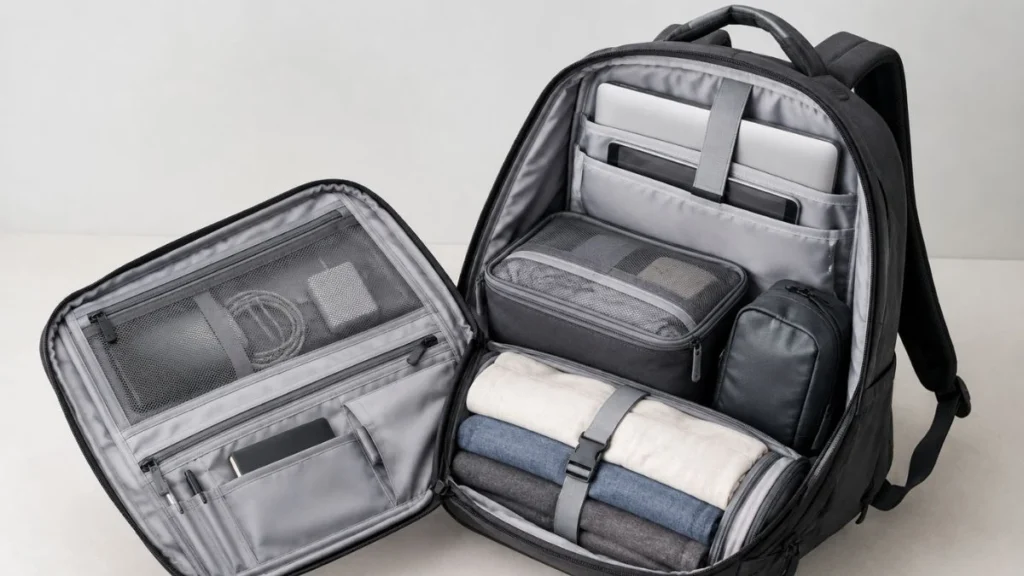
The best carry-on backpack isn’t the one with the most features — it’s the one sized correctly for your trip length (most travelers land in a 20–45L range), built with genuine organization rather than one giant compartment, and comfortable enough to wear loaded for a full day of walking. Clamshell (suitcase-style) opening, a dedicated laptop sleeve, and airline-compliant dimensions are the three features that consistently separate a genuinely useful travel backpack from a repurposed hiking pack.
Carry-on backpacks have become the default travel bag for a growing share of travelers precisely because they solve the two biggest annoyances of rolling luggage — struggling over uneven ground and getting stuck behind slow-moving crowds — while still holding a week or more of gear. But “backpack” covers an enormous range of designs, and picking the wrong one for your specific travel style is a common, avoidable mistake.
Quick Facts
- Size range: Most travelers do well somewhere between 20L (personal-item-sized, gate-check-avoidance focused) and 45L (max carry-on capacity for longer or colder trips)
- Clamshell opening: A suitcase-style opening that unzips flat, letting you see and access your entire main compartment at once — widely preferred over top-loading designs for actual packing convenience
- Organization over capacity: A well-structured 30L bag with dedicated compartments typically outperforms a poorly organized 40L bag for daily usability
- Laptop protection: A padded, suspended laptop sleeve (rather than a simple flat pocket) better protects electronics from impact, especially if the bag gets set down or bumped
- Materials: Ballistic nylon and technical sailcloth fabrics with water-resistant zippers are increasingly standard on durable travel backpacks, trading some weight for meaningfully better weather and abrasion resistance
- Hip belt: Genuinely useful for heavier loads or extended carrying; less necessary for travelers packing light or using the bag mainly for short airport transfers
Getting the Size Right Comes First
Before comparing specific features, the size decision shapes everything else about how a backpack performs for you. Travelers focused on avoiding gate-check and minimizing bulk tend to do best in the 20–30L range, sized to work as a personal item or a compact carry-on for shorter trips. Travelers packing for longer trips, colder climates, or simply preferring fewer packing compromises tend to land in the 35–45L range, which typically represents the upper limit most airlines allow for carry-on dimensions. It’s worth being explicit that bigger isn’t automatically better here — a poorly organized 40L bag can feel more cramped and harder to use than a well-structured 30L bag, since usable space depends as much on internal layout as on raw volume.
Why Clamshell Opening Beats Top-Loading
One of the more consistently praised design features across current travel backpacks is a clamshell, suitcase-style opening — the bag unzips flat like a traditional suitcase rather than requiring you to dig down through a single top opening the way older-style backpacking packs do. This matters enormously for actual daily use: security checkpoints, hotel room repacking, and quick access to items buried mid-bag are all considerably easier with a clamshell design, since you can see and reach your entire main compartment at once instead of unpacking from the top down to find something near the bottom.
Organization Beats Raw Capacity
A recurring theme across current travel backpack reviews is that internal structure matters more to real-world usability than total liter capacity. A bag built around dedicated zones — a separate compartment for clothes, a suspended laptop sleeve, smaller pockets for chargers and cables, and a distinct space for toiletries — makes finding things fast and predictable. A large, undivided single compartment, by contrast, tends to turn into a jumble where locating a passport or charger takes longer than it should, regardless of how much total space the bag technically offers.
Protecting Electronics Properly
If you’re traveling with a laptop or other electronics, the quality of the laptop compartment specifically is worth scrutinizing rather than assuming any padded sleeve is equivalent. A suspended laptop sleeve — one that keeps the laptop slightly elevated off the bottom of the bag rather than resting directly against it — offers meaningfully better protection if the bag is set down hard or bumped during transit, since the suspension absorbs some of that impact before it reaches the device.
Materials and Durability
Fabric choice affects both how a backpack holds up over repeated trips and how much it weighs empty. Technical fabrics like ballistic nylon or sailcloth-style materials, paired with water-resistant zippers, have become increasingly common on durable travel-focused packs, offering real protection against rain and abrasion at the cost of a bit more weight than a basic nylon bag. For travelers prioritizing long-term durability over shaving off every possible gram, this tradeoff is generally worth making.
Conclusion
A genuinely good carry-on backpack comes down to matching size to your actual trip length, prioritizing internal organization over raw capacity, and choosing a clamshell opening with a properly suspended laptop sleeve if you’re traveling with electronics. Durable, water-resistant materials add real value for frequent travelers, while features like a hip belt matter mainly if you’re carrying real weight for extended periods rather than making quick airport transfers.
FAQ
What size backpack is best for carry-on travel?
Most travelers do well somewhere between 20L and 45L depending on trip length — 20–30L suits shorter trips or travelers avoiding gate-check entirely, while 35–45L suits longer or colder-weather trips, generally representing the upper edge of most airlines’ carry-on size allowances.
Is a clamshell-opening backpack better than a top-loading one for travel?
For most travelers, yes. A clamshell design unzips flat like a suitcase, letting you see and access your entire main compartment at once, which is generally considered more practical for daily packing and repacking than digging through a single top opening.
Does a bigger backpack mean more usable space?
Not necessarily. Internal organization matters as much as raw capacity — a well-structured 30L bag with dedicated compartments can feel more usable than a poorly organized 40L bag where everything ends up in one undivided space.
What should I look for to protect a laptop in a travel backpack?
A suspended, padded laptop sleeve that keeps the laptop slightly elevated within the bag, rather than a simple flat pocket. This offers meaningfully better protection if the bag is set down hard or bumped during transit.
Do I need a hip belt on a carry-on backpack?
It depends on your travel style. A hip belt is genuinely useful if you’re carrying a heavier load or walking with the bag for extended periods, but it’s less necessary if you pack light or mainly use the bag for short airport transfers.
Backpack choice connects to other packing-strategy topics — see Backpack Personal Item Rules and Best Travel Neck Pillow for related Flight Gear and Flight Hacks content.