Last updated: 3 August 2026
On most connecting flights, your checked bag is tagged straight through to your final destination and transferred automatically between aircraft — you won’t see it again until baggage claim at the end of your trip. The one major exception: if you’re arriving from an international flight and connecting onward, you’ll usually need to collect your bag, clear customs, and recheck it yourself before your next flight, because customs clearance requires the bag to physically pass through with you.
Checked luggage during a layover is one of those things travelers worry about disproportionately to how often it actually goes wrong — but the anxiety makes sense, because the rules genuinely do change depending on your itinerary. Same-airline domestic connections are close to invisible: tag it once, don’t think about it again. Cross an international border partway through your trip, and suddenly you’re the one moving the bag, not the airline.
Quick Facts
- Same ticket, same or partner airline: Bag is tagged to your final destination and transferred automatically — you don’t touch it during the layover
- Arriving internationally with a US connection: You must collect your bag, clear customs, and recheck it yourself before continuing — this applies even if your final destination is a different US city
- Separate tickets, no interline agreement: You’ll need to collect your bag at claim and recheck it with the next airline yourself, regardless of whether the connection is domestic or international
- Interline/codeshare agreements: Many airlines have agreements allowing bags to transfer automatically even across different carriers, but this isn’t universal — some airlines (notably certain low-cost carriers) don’t interline bags at all
- Basic Economy caveat: Some airlines’ interline baggage agreements don’t apply to their cheapest fare tiers, even when a partner airline is otherwise involved
- Tagging: Each checked bag gets a unique barcode/RFID tag linking it to your full itinerary, which is what lets ground staff route it correctly without you handling it
The Default Case: Automatic Transfer
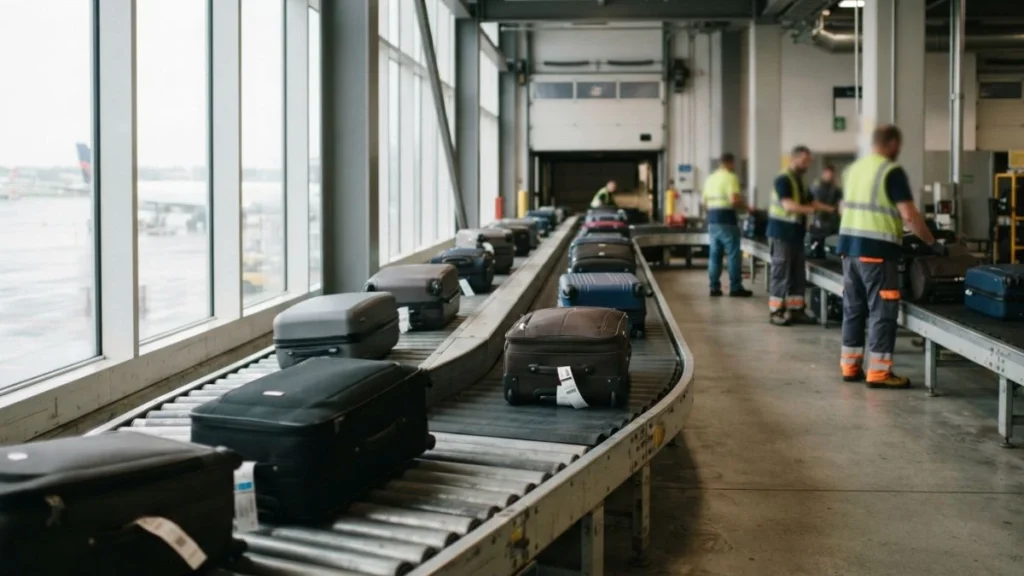
If your entire itinerary is on one ticket with the same airline (or airlines that have an interline agreement covering your route), your bag is tagged once, at your very first check-in counter, straight through to your final destination. Ground crews transfer it between aircraft during your layover using that tag — you’re not involved at any point, and in most cases you genuinely won’t see the bag again until you land at your last stop. This is the scenario most travelers experience, and it’s why “just don’t worry about the bag” is generally sound advice for standard connecting itineraries on a single ticket.
The Exception: Connecting Through Customs
The one situation that reliably breaks the “don’t touch your bag” rule is arriving internationally with a connecting flight onward — most commonly, landing in the US from abroad and connecting to another US city. Because customs clearance legally requires inspecting what’s entering the country, you have to physically collect your checked bag at the first port of entry, carry it through customs yourself, and then recheck it for your next flight. This is true even if your final destination is domestic and even if your bag was originally tagged all the way through — the customs step overrides the through-tag. It’s the main reason airlines recommend building extra connection time into itineraries that cross an international border partway through.
Separate Tickets Change Everything
If you booked your connection as two separate tickets rather than one itinerary — a common move when piecing together a cheaper routing — the automatic-transfer assumption often doesn’t apply at all, regardless of whether the connection is domestic or international. Airlines generally only agree to through-check baggage when the full journey is on a single ticket (or specific partner tickets with a formal agreement), and several major carriers explicitly warn that baggage won’t transfer between separately ticketed flights. If you’ve self-connected on separate tickets, plan on collecting your bag and rechecking it yourself at the connection point — and build in the extra time that requires.
Interline Agreements: The Part Most Travelers Don’t See
Behind the scenes, whether your bag transfers automatically often comes down to whether the airlines involved have an interline (or codeshare) baggage agreement — a formal arrangement that lets one airline hand your bag off to another without you being the one to carry it between them. Alliance membership (like Star Alliance or oneworld) generally makes this more likely, but it isn’t automatic just because two airlines share an alliance, and it isn’t guaranteed at all for airlines with no such agreement — some low-cost carriers specifically don’t interline bags with anyone. If your itinerary mixes airlines, checking each carrier’s stated baggage policy for your specific routing is worth the few minutes it takes, rather than assuming alliance membership settles the question.
Conclusion
For the large majority of travelers on a single-ticket itinerary with the same airline or a genuine interline partner, checked bags during transit are close to a non-issue — tag it once, collect it at your final stop. The situations that require your involvement are predictable: crossing an international border partway through your trip (customs forces a recheck), or connecting between separately ticketed flights with no interline agreement. Knowing which category your itinerary falls into before you fly is the difference between a relaxed layover and an unexpected scramble through baggage claim.
FAQ
Do I need to collect my checked bag during a layover?
Usually not, if your itinerary is on one ticket with an airline or partner that through-checks baggage — it transfers automatically between flights. The main exception is connecting through customs after an international arrival, where you must collect and recheck the bag yourself.
Does my checked bag transfer automatically on an international connecting flight?
It depends on where the connection happens. If you’re arriving internationally and continuing onward from that same country without crossing a customs border again, it often transfers automatically. If you’re arriving internationally and connecting through a country that requires you to clear customs and immigration first, you’ll need to collect and recheck the bag yourself.
What happens to my bags if I booked two separate tickets for a connection?
In most cases, checked baggage does not transfer automatically between separately ticketed flights, even on the same airline or route. You’ll typically need to collect your bag at baggage claim and check it in again for your next flight, so plan extra connection time accordingly.
Do all airlines have interline baggage agreements with each other?
No. Interline agreements are individual arrangements between specific airlines, and not every pair of carriers has one — some low-cost airlines don’t interline bags with any other carrier at all. Always check the specific policy for the airlines on your itinerary rather than assuming.
Can Basic Economy tickets get through-checked baggage on connecting flights?
Sometimes not. A few airlines’ interline agreements specifically exclude their lowest fare tier, even when a partner airline is otherwise part of the itinerary. It’s worth confirming this directly with the airline if you’re booked on a Basic Economy or equivalent fare.
Baggage handling ties directly into how much buffer you need at each connection point — see Can You Leave Airport During Layover? Rules & Timing Explained and How Early Should You Arrive for an International Flight? for the timing side of the same decision.