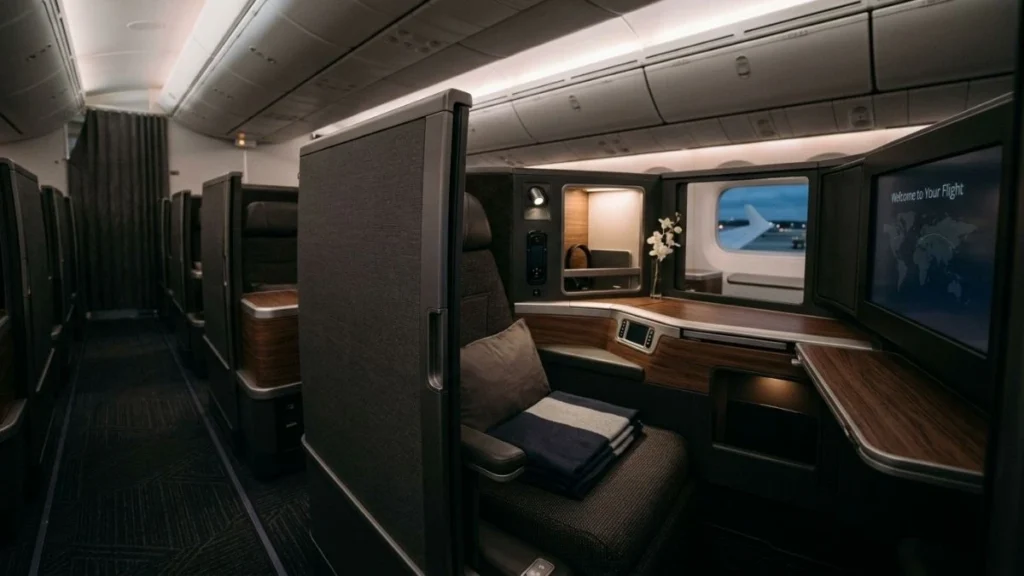
There’s no decisive overall winner between ANA and JAL — both consistently rank among the best long-haul carriers in the world, and NerdWallet’s own head-to-head comparison calls it “an ever-so-slight victory” for ANA overall, while acknowledging travelers really can’t lose with either. The meaningful differences come down to specifics: ANA’s “The Room” business class is the widest in commercial aviation, JAL’s 787 economy is the only 2-4-2 configuration in the sky (Boeing’s original intended layout), and the two airlines belong to different alliances entirely — ANA to Star Alliance, JAL to oneworld.
Comparing ANA and JAL isn’t really a search for a clear loser — both are Japanese carriers with a well-earned reputation for exceptional service across every cabin class, and the honest answer to “which is better” depends heavily on which specific cabin, aircraft, route, and loyalty program actually matters to your trip.
Quick Facts
- Overall verdict: Close to a toss-up — NerdWallet’s comparison gives ANA a slight edge overall, but stresses both airlines deliver a much-better-than-expected experience
- Alliance: ANA belongs to Star Alliance (partners include United); JAL belongs to oneworld (partners include American) — this affects which airline’s miles and status matter to you long-term
- Business class hardware: ANA’s “The Room” is the widest business class seat in commercial aviation (78 x 38 inches) with a sliding door, but is only on select 777s; JAL’s newer A350-1000 “JAL Suite” offers a fully enclosed suite with closing doors, deployed on 11 aircraft to JFK, LAX, DFW, Heathrow, and Paris CDG as of early 2026
- Economy seat width: JAL’s Boeing 787 economy uses a 2-4-2 layout (Boeing’s originally intended configuration), widely cited as the widest 787 economy seat in the sky — this advantage only applies on 787-operated JAL flights specifically
- Checked baggage: ANA includes at least two free checked bags up to 50 lbs (23kg) on many fares; JAL only charges for extra-legroom exit row seat selection, while ANA charges for standard seat selection on discount economy fares
- Hub location: JAL favors Tokyo Haneda (closer to central Tokyo); ANA splits operations between Haneda and Narita
Business Class: Two Different Philosophies
This is where the two airlines diverge most distinctly. ANA’s flagship “The Room” — available on a relatively small subset of roughly ten refurbished 777-300ERs — is widely regarded as one of the most spacious business class products anywhere, with high walls and a sliding door creating a genuinely private, suite-like feel, and a seat width that outmeasures nearly every competitor. The catch is availability: outside those specific refurbished aircraft, ANA’s other 777s and 787s fly an older staggered flat-bed product that, while solid, isn’t the same experience — worth checking your specific aircraft before booking if The Room is the reason you’re choosing ANA.
JAL counters with its newer Airbus A350-1000, featuring the “JAL Suite” — a fully enclosed business suite with closing doors, deployed on 11 aircraft as of early 2026 covering routes to JFK, LAX, Dallas-Fort Worth, London Heathrow, and Paris CDG. It’s narrower than ANA’s Room, but multiple reviewers describe it as feeling cozier and more personally enclosed rather than simply smaller, with the added benefit of a closing door that The Room’s older staggered product on non-refurbished aircraft doesn’t offer. Where JAL still flies its older Sky Suite product, it remains a well-regarded 1-2-1 flat bed with direct aisle access, just without ANA’s Room-level width.
Economy: JAL’s Narrow but Real Advantage
The most concrete, measurable economy difference between the two airlines comes down to a single aircraft type. JAL is the only major airline that kept the Boeing 787’s economy cabin in its originally intended 2-4-2 configuration, rather than the denser 9-abreast layout most carriers, including ANA, have since adopted — making JAL’s 787 economy seat the widest economy seat available on that aircraft type industry-wide. This advantage is specific to 787-operated JAL flights, though; on routes or aircraft where JAL isn’t flying a 787, this particular edge disappears, and reviewers note that service, food, and entertainment are otherwise broadly comparable between the two airlines’ standard economy products.
Baggage and Fees: A Smaller but Real Difference
Beyond the seat itself, ANA and JAL handle certain fees slightly differently in ways that can matter depending on how you travel. ANA includes at least two free checked bags up to 50 lbs (23kg) on many fare types, a generous baseline compared to many international carriers. On the seat-selection side, though, ANA charges for standard seat selection on its discount economy fares, while JAL only charges for extra-legroom exit row seats specifically — meaning JAL’s baseline standard seat selection tends to come at less added cost on comparable fares.
Why Alliance Membership Might Decide It for You
For travelers who fly Japan or the broader region regularly, the underlying alliance difference can matter more over time than any single seat comparison. ANA belongs to Star Alliance, giving it strong connections through partners like United, while JAL belongs to oneworld, connecting well through American Airlines and Cathay Pacific among others. If you already hold meaningful status or a mileage balance in one alliance, that existing relationship may be a more practical deciding factor than comparing hard product specs in isolation, since your miles and elite recognition will only carry real value within whichever alliance you’re already invested in.
Conclusion
ANA and JAL are close enough in overall quality that the “better” choice comes down to your specific priorities rather than a clear universal winner. ANA’s Room delivers the widest business seat in the sky on select aircraft; JAL counters with a newer enclosed suite and the industry’s widest 787 economy seat. Beyond the hardware, which alliance you’re already invested in, and which Tokyo airport (Haneda versus Narita) better suits your itinerary, are often the more practical tiebreakers.
FAQ
Is ANA or JAL better overall?
It’s close. NerdWallet’s head-to-head comparison gives ANA a slight overall edge, but both consistently rank among the world’s best long-haul carriers, and the more useful comparison depends on which specific cabin, aircraft, and route you’re actually booking.
Which airline has the better business class, ANA or JAL?
ANA’s “The Room” is the widest business class seat in commercial aviation, available on a limited number of refurbished 777s. JAL’s newer A350-1000 “JAL Suite” offers a fully enclosed suite with closing doors on a growing number of routes. Which is “better” depends on whether you prioritize maximum width or enclosed privacy.
Is JAL’s economy class really wider than ANA’s?
On Boeing 787 aircraft specifically, yes — JAL kept the 2-4-2 configuration Boeing originally intended, making it the widest 787 economy seat in the industry. This advantage doesn’t apply on JAL flights operated by other aircraft types.
Do ANA and JAL belong to the same airline alliance?
No. ANA is a Star Alliance member (connecting well through United), while JAL belongs to oneworld (connecting well through American Airlines). This affects which airline’s miles and elite status will carry more long-term value depending on your existing loyalty program relationships.
Does ANA or JAL include more free checked baggage?
ANA typically includes at least two free checked bags up to 50 lbs (23kg) on many fares. JAL’s baggage policies are comparable, though the two airlines differ slightly on seat-selection fees — JAL only charges for extra-legroom exit rows, while ANA charges for standard seat selection on discount economy fares.
Comparing specific carriers connects to broader Airlines pillar content — see Qatar Airways Economy Review and Best Airline Alliances Explained for related comparisons.
Official Sources
No single government or official authority source was used; the cabin product and baggage policy comparisons are drawn from several independent reviews (including NerdWallet and other aviation travel publications) that are consistent with each other as of mid-2026, rather than a single claim requiring one authoritative reference. Fleet configuration and fare policies change over time — manual verification on each airline’s official site is recommended before publishing.