Last updated: 3 August 2026
The core difference isn’t just ticket price — it’s business model. Low-cost carriers keep fares low by using a single aircraft type, charging separately for nearly everything beyond the seat itself, and focusing on individual route profitability. Full-service airlines build higher fares around network-wide profitability, multiple cabin classes, included amenities, and a broader fleet — often deliberately keeping a marginal route alive because it feeds passengers into a more profitable one elsewhere in their network.
The line between these two models has blurred considerably as full-service airlines introduced Basic Economy to compete on price, and low-cost carriers added premium seating options to capture higher-spending travelers. But underneath that surface-level convergence, the underlying business logic each type runs on is still genuinely different — and understanding it explains a lot about why the same route can feel so different depending on which type of airline you book.
Quick Facts
- Fleet strategy: Low-cost carriers typically operate a single aircraft type to minimize training, maintenance, and spare-parts costs; full-service airlines run multiple aircraft types across their network
- Route strategy: Low-cost carriers evaluate and often drop individual routes based on standalone profitability; full-service airlines will keep a marginal route running if it feeds passenger traffic into a more profitable hub connection
- Revenue model: Low-cost carriers rely heavily on ancillary fees (seats, bags, food); full-service airlines draw from a broader mix of income sources including cargo, premium cabins, and loyalty programs
- What’s included: Full-service fares commonly bundle a checked bag, seat selection, and meals; low-cost fares typically charge separately for all of these as add-ons
- Cabin classes: Many low-cost carriers offer just one class of service, though some now add a premium economy tier; full-service airlines typically offer several tiers from economy through first or business
- Safety: Independent industry assessments have found low-cost carriers maintain accident rates comparable to or better than the industry average — the “low-cost” model applies to operating costs, not safety standards
Why the Fleet Looks So Different
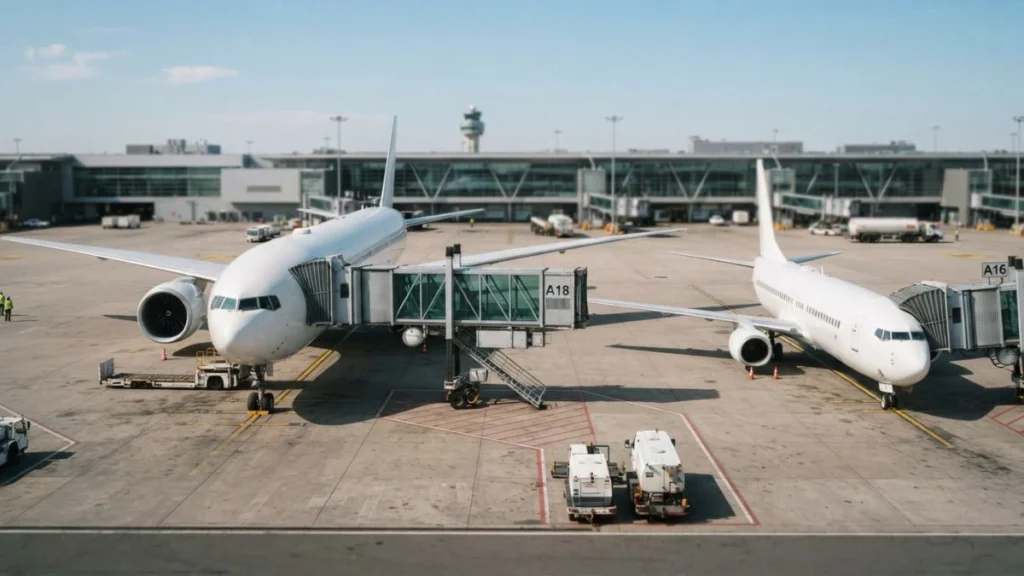
One of the clearest structural differences shows up before a passenger ever boards: low-cost carriers overwhelmingly favor operating a single aircraft type across their entire fleet — Southwest and Ryanair both run exclusively Boeing 737 family aircraft, for instance. This isn’t a coincidence; a single aircraft type dramatically simplifies pilot training, maintenance expertise, and spare-parts logistics, all of which reduce operating costs in ways that compound across a large fleet. Full-service carriers, by contrast, typically operate several different aircraft types suited to different route lengths and passenger volumes — a strategy that costs more to maintain but allows more flexibility in matching aircraft size to specific route demand.
Why a Route Can Survive Even When It Loses Money
This is one of the less visible but genuinely important differences: full-service airlines often evaluate profitability at the network level rather than route by route. A route that loses money on its own can still be worth keeping if it reliably feeds passengers into a more profitable long-haul connection through the airline’s hub — the classic model behind hub-and-spoke networks. Low-cost carriers generally don’t operate this way; they assess each route on its own performance, and a route that doesn’t meet yield and load-factor targets gets dropped or shifted seasonally, sometimes with very little advance notice, since low-cost carriers typically have less sunk investment in any single route to begin with.
Where the Ticket Price Actually Goes
The most visible difference to travelers — the price itself — reflects genuinely different revenue strategies underneath. Low-cost carriers deliberately keep the base fare as low as possible and recover revenue instead through ancillary fees: checked bags, seat selection, in-flight food and drinks, and sometimes even carry-on bags, all priced separately rather than bundled in. Full-service airlines build a higher base fare that typically includes more of this by default — a checked bag, a meal on longer routes, and often a level of seat selection flexibility that a low-cost fare wouldn’t include without an extra charge.
The Line Has Genuinely Blurred
It’s worth acknowledging that this distinction isn’t as clean as it used to be. Many full-service airlines introduced Basic Economy fares specifically to compete with low-cost carriers on headline price, stripping out many of the traditionally included perks and adding change or seat-selection fees that mirror the low-cost model closely. At the same time, some low-cost carriers have added premium cabin options to capture travelers willing to pay more for comfort. The result is that “low-cost” and “full-service” describe a business model and cost structure more reliably than they describe any single, guaranteed passenger experience on a specific fare.
The Safety Question, Addressed Directly
It’s a common and understandable assumption that lower fares mean lower safety standards — but this doesn’t hold up against independent industry data. Aviation safety assessments have consistently found that low-cost carriers maintain accident rates comparable to, or in some evaluations better than, the broader industry average. The cost savings in the low-cost model come from operational efficiency — a single aircraft type, standardized processes, lean ancillary-fee revenue — not from cutting corners on maintenance or safety standards, which remain governed by the same aviation regulators regardless of an airline’s pricing model.
Conclusion
Choosing between a low-cost and full-service airline isn’t really a choice about safety or basic reliability — both operate under the same regulatory safety standards. It’s a choice about what you want bundled into the ticket price versus what you’d rather pay for separately, and how much you value network flexibility (easier rebooking through a hub) versus the lowest possible headline fare. Understanding the underlying business model each type runs on makes it much easier to predict what you’re actually getting before you book, rather than being surprised by the add-on fees once you’re checking in.
FAQ
Are low-cost airlines less safe than full-service airlines?
No. Independent aviation safety assessments have found low-cost carriers maintain accident rates comparable to or better than the broader industry average. The cost savings in the low-cost model come from operational efficiency, not from lower safety standards, which are governed by the same regulators for both types of airline.
Why do low-cost airlines charge for things full-service airlines include for free?
Because their business model is built around a low base fare recovered through separate ancillary fees — bags, seat selection, food — rather than a higher bundled fare. Full-service airlines typically build more of this into the ticket price by default.
Do full-service airlines ever keep unprofitable routes running?
Yes, commonly. Full-service airlines often evaluate profitability at the network level, and a route that loses money on its own can still be kept if it reliably feeds passengers into a more profitable hub connection elsewhere in the airline’s network.
Is Basic Economy the same as flying a low-cost carrier?
Not exactly, though it’s designed to compete with that pricing model. Basic Economy is a stripped-down fare tier offered by full-service airlines specifically to match low-cost carrier pricing, but it exists alongside the airline’s other, more inclusive fare classes rather than being the airline’s only offering.
Why do low-cost airlines usually fly only one type of aircraft?
Operating a single aircraft type significantly reduces training, maintenance, and spare-parts costs across the fleet, which is a core part of how low-cost carriers keep their overall operating costs — and therefore base fares — lower than full-service airlines.
This connects to other fare and airline-comparison topics — see How to Read Fare Classes Like a Pro and Can Airlines Change Your Seat? for related booking and cabin-experience topics.