Last updated: 3 August 2026
Yes — the TSA allows both prescription and over-the-counter medication in carry-on and checked baggage, and liquid medications specifically are exempt from the standard 3.4-ounce liquid limit, even in quantities larger than that. You do need to declare medically necessary liquids, gels, and creams to the officer at the checkpoint and remove them from your bag for separate screening, but there’s no TSA-imposed cap on how much medication you can bring.
Medication is one of the few carry-on categories where the usual liquid restrictions genuinely don’t apply the way they do to everything else in your bag — but that exemption comes with its own small set of steps at the checkpoint, and skipping them is what tends to slow travelers down rather than the medication itself.
Quick Facts
- Allowed: Prescription and over-the-counter medications in both carry-on and checked baggage, with no TSA-imposed quantity limit
- Liquid medication exemption: Liquid, gel, or cream medications can exceed the standard 3.4-ounce (100 ml) limit and don’t need to go in the quart-sized bag with other liquids
- What you must do: Declare medically necessary liquids to the TSA officer at the start of screening and remove them from your bag to be screened separately
- Original packaging: Not required by TSA, but strongly recommended — original labeled containers help at the checkpoint and are often required for international customs or if questioned about a controlled substance
- Cooling supplies: Ice packs, gel packs, and freezer packs used to keep medication cold are allowed, whether frozen, partially melted, or fully melted
- Documentation: Generally not required for standard prescriptions on domestic travel, but a prescription copy or doctor’s letter is recommended for controlled substances, injectable medications, or unusually large quantities
What TSA Actually Allows
Per TSA’s own guidance, all medication — prescription and over-the-counter alike — is permitted through security checkpoints in both carry-on and checked bags. The detail that surprises a lot of travelers is that this extends fully to liquid, gel, and cream medications, which are specifically exempt from the 3-1-1 rule that limits other liquids to 3.4-ounce containers inside a single quart-sized bag. There’s no TSA-set ceiling on how much medication you can travel with — the standard is a “reasonable quantity for your trip,” which in practice means bringing what you’d genuinely need, rather than an arbitrary hard number.
How to Actually Get Through the Checkpoint
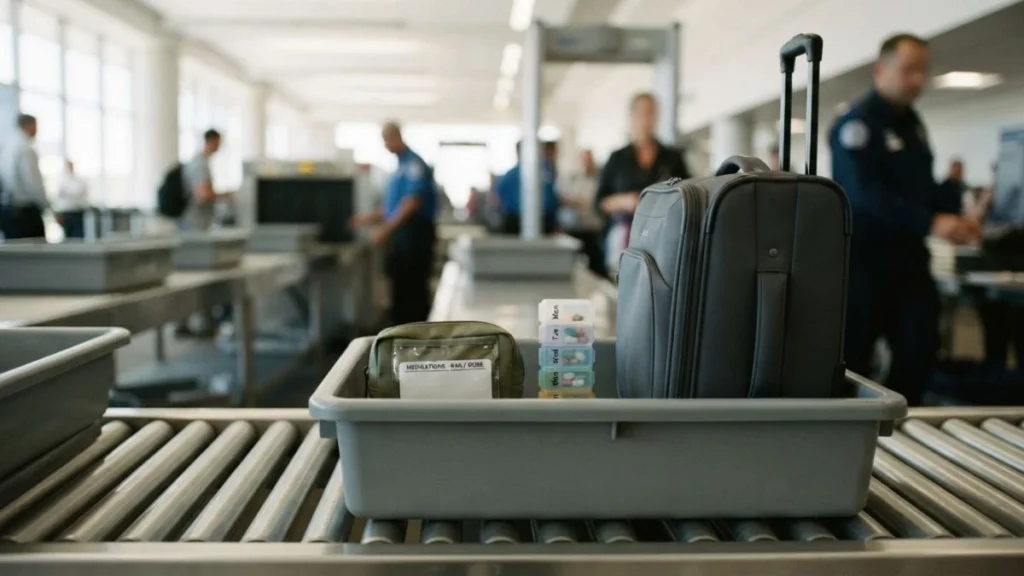
The exemption isn’t automatic in the sense of being invisible to the screening process — you still need to flag it. TSA’s guidance is to inform the officer that you’re carrying medically necessary liquids or medications before screening begins, then remove those items from your carry-on and place them in a bin or bowl separate from your other belongings, along with related supplies like syringes, pumps, or IV bags if you’re carrying them. If a medically necessary liquid triggers an alarm during screening, additional inspection is required, and in rare cases where the alarm can’t be resolved, the item may not be allowed through — which is one more reason declaring it upfront, rather than hoping it passes unnoticed, is the more reliable approach.
Do You Need the Original Bottle?
TSA itself doesn’t require medication to be in its original prescription packaging to pass through security. That said, it’s worth doing anyway for reasons beyond the checkpoint itself: original labeled bottles are useful if a TSA officer has questions, are commonly expected at international customs, and can matter significantly if you’re carrying a controlled substance and need to demonstrate it’s legitimately prescribed to you. A pill organizer is fine for daily convenience, but keeping the original bottles in your bag alongside it covers you in situations a loose pill organizer alone doesn’t.
Cooling Supplies and Medical Devices
If your medication needs refrigeration — insulin and certain biologics being the most common examples — TSA allows ice packs, gel packs, and freezer packs to travel with it, and they’re permitted whether frozen solid, partially melted, or fully melted by the time you reach the checkpoint. Insulin pumps and continuous glucose monitors attached to your body are subject to additional screening, which may include a visual inspection and a self pat-down of the device rather than requiring you to remove it. If you’re traveling with larger medical equipment or supplies, expect a separate screening process for those items specifically.
When Documentation Actually Matters
For most travelers carrying standard prescription medication on domestic trips, no paperwork is required beyond the medication itself. Where documentation becomes genuinely useful — sometimes close to necessary — is with controlled substances, injectable medications, or quantities noticeably larger than what a typical trip would call for, where a copy of the prescription or a letter from your doctor can prevent a checkpoint conversation from turning into a delay. International travel adds another layer entirely: some countries restrict or ban medications that are perfectly legal and common in the US, so checking the destination country’s specific rules before you fly matters just as much as clearing TSA at home.
Conclusion
Medication gets meaningfully more flexibility at airport security than almost anything else in your bag — no quantity cap, and a specific exemption from the standard liquid limit for anything liquid, gel, or cream-based. The tradeoff is a small set of active steps: declaring it, separating it for screening, and ideally keeping it in original, labeled packaging. Skipping those steps, not the medication itself, is what tends to slow travelers down at the checkpoint.
FAQ
Can I bring liquid medication over 3.4 ounces on a plane?
Yes. Liquid, gel, and cream medications are specifically exempt from the standard 3.4-ounce liquid limit and don’t need to fit in the quart-sized liquids bag, as long as you declare them to the TSA officer and have them screened separately.
Do I need a doctor’s note to bring medication through airport security?
Not for most standard prescriptions on domestic travel. It’s generally recommended, though not required, for controlled substances, injectable medications, or unusually large quantities, and it can help avoid delays if questions come up at the checkpoint.
Does medication need to be in its original prescription bottle?
TSA doesn’t require it, but it’s strongly recommended. Original labeled containers help speed up screening, are commonly expected at international customs, and matter especially if you’re carrying a controlled substance.
Can I bring ice packs to keep medication cold on a flight?
Yes. TSA allows ice packs, gel packs, and freezer packs for keeping medically necessary items cold, and they’re permitted whether frozen, partially melted, or fully melted by the time you reach screening.
Is there a limit on how much medication I can bring on a plane?
No specific quantity cap is set by TSA — the general standard is bringing a reasonable amount for your trip. Unusually large quantities may prompt questions at the checkpoint, where documentation can help confirm it’s legitimate.
Medication and other checkpoint essentials connect to broader carry-on planning — see Backpack Personal Item Rules and How Early Should You Arrive for an International Flight? for related packing and timing topics.